The LED-versus-CFL question was settled years ago, yet most homes still run a mix of old CFLs, a few surviving incandescent bulbs, and a handful of LEDs. That mix is quietly costing money, because lighting technology is one of the few areas where the newest option is also the cheapest to run by a wide margin. This is the real math on LED, CFL, and incandescent bulbs, plus an honest answer on whether smart bulbs justify their higher price. The short version: switch everything to LED today, and treat smart bulbs as an optional convenience.
Lighting is a smaller slice of energy use than heating, cooling, or water heating, so do not expect it to transform your costs. But LEDs are so cheap to run and so long-lived that switching is close to free money, and there is no reason to keep paying more to light the same room.
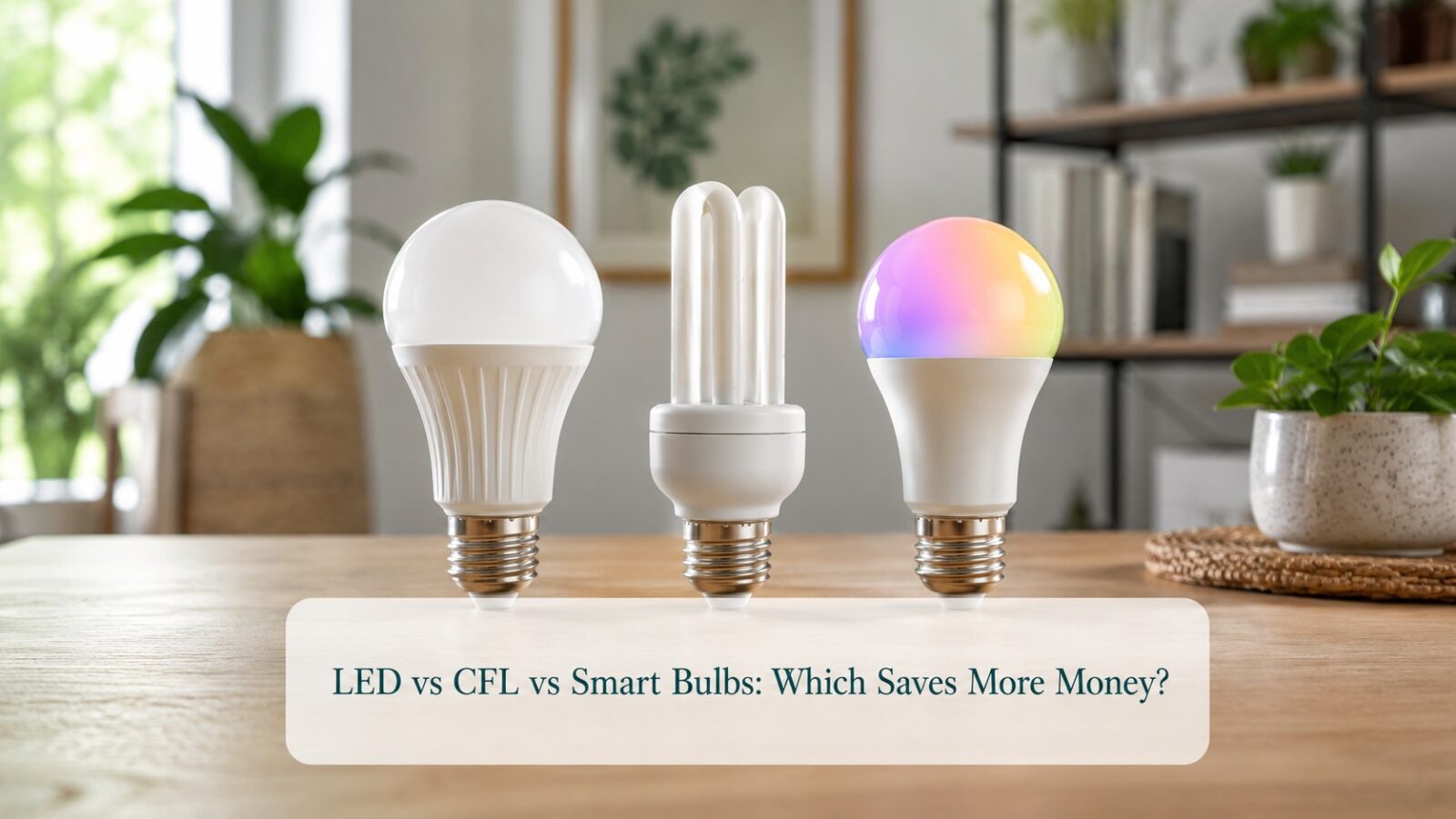
The three technologies compared
Incandescent (obsolete)
The original bulb, now effectively obsolete. It wastes most of its energy as heat, lasts only about a thousand hours, and costs the most to run. If any remain in your home, replace them first.
CFL (yesterday’s upgrade)
The compact fluorescent was a big improvement on incandescent and dominated for a decade. It uses far less power but still more than an LED, takes a moment to reach full brightness, contains a small amount of mercury, and lasts a fraction as long. There is no reason to buy one today.
LED (the clear winner)
LEDs use 75-85% less than incandescent and meaningfully less than CFL, switch on instantly, last 15,000-25,000 hours, and contain no mercury. They have become cheap, and they pay back within months. For ordinary lighting, the decision is over.
The real cost math
Replacing an old incandescent with an equivalent LED cuts that bulb’s energy by around 85%. Across a whole home of ten or more bulbs running several hours a day, the annual saving is real, and the long life means you also stop buying replacement bulbs every year. A CFL saves less than an LED and dies sooner, so even where CFLs still work, replacing them with LEDs usually pays off over the bulb’s life. This is exactly why LED conversion tops our list of ways to lower home energy costs.
Where smart bulbs fit
Smart bulbs are LEDs with networking added, so they share the same low running cost. What you pay extra for is control: dimming, scheduling, colour, and voice or app operation. On pure energy savings they barely beat an ordinary LED, saving a little by ensuring lights are never left on and can be dimmed. Their value is convenience, and whether that is worth the premium depends on you. For the broader question of which connected devices actually cut energy use, see our roundup of smart devices for energy savings.
- Worth it where you genuinely use scheduling, dimming, or remote control, such as outdoor or hard-to-reach lights.
- Worth it for one or two accent or mood lights, not a whole home.
- Skip for ordinary rooms where a plain LED does the same job for a fraction of the price.
Choosing the right LED
Not all LEDs are equal, and a few specs decide whether you are happy with the light.
- Brightness is measured in lumens, not watts; match the lumens to the room rather than guessing by wattage.
- Colour temperature sets the mood: warm white for living and bedrooms, cool white for kitchens and workspaces.
- Look for a good energy-efficiency rating and buy from reputable brands for honest lifespan claims.
- Choose a dimmable LED only if you have a compatible dimmer, or the bulb may flicker.
What about tube lights and outdoor lighting?
The same logic extends beyond ordinary bulbs. Old fluorescent tube lights have efficient LED tube replacements that drop into the existing fitting and cut consumption while giving brighter, instant light. Outdoor and security lighting, which often runs for hours every night, is where LEDs save the most over time, and pairing them with a timer or daylight sensor so they are never left on by accident multiplies the saving. Replacing the lights that burn longest each day, indoors or out, returns the most for the least effort.
Common mistakes
- Keeping working CFLs out of thrift, when LEDs often pay back over the bulb’s remaining life.
- Buying smart bulbs for every room expecting big savings rather than convenience.
- Choosing bulbs by watts instead of lumens and ending up too dim or too bright.
- Mismatching colour temperature to the room, making a bedroom feel like an office.
- Buying the cheapest no-name bulbs, which often fail far short of their claimed life.
Editor’s note
This is the rare home decision with no real debate left: replace every incandescent and CFL with LEDs, starting with the bulbs that burn longest each day. The saving per bulb is modest, but it is reliable, lasts for years, and the bulbs have become cheap. Treat smart bulbs as a nice-to-have for the few places where scheduling or dimming genuinely helps, and do not let their price tempt you into thinking they are a big energy saver. They are not; they are convenient LEDs.
Frequently asked questions
Are LEDs really cheaper than CFLs to run?
Yes. LEDs use less electricity than CFLs and last several times longer, so they cost less both to run and to replace. There is no running-cost reason to choose a CFL today.
Do smart bulbs save electricity?
Only a little beyond a normal LED, mainly by preventing lights being left on and allowing dimming. You pay extra for control and convenience, not for meaningful energy savings.
How do I choose the right brightness?
Go by lumens, not watts. Higher lumens mean a brighter bulb; match the figure to the room’s size and purpose, and choose warm white for relaxing spaces and cool white for kitchens and workspaces.
Should I replace working CFLs with LEDs now?
In most cases, yes, especially for bulbs that run several hours a day. Even though the CFL still works, an LED uses less electricity and lasts far longer, so the replacement usually pays for itself over the LED’s life while you stop buying bulbs as often. Start with the lights that burn longest, as in our guide to a greener home. For little-used bulbs, it is fine to wait until the CFL fails.
The bottom line
LEDs win on every measure that matters: running cost, lifespan, and instant brightness, with no mercury. Replace any incandescent and CFL bulbs with LEDs now, choosing by lumens and colour temperature, and reserve smart bulbs for the handful of spots where scheduling or dimming is genuinely useful. It is the simplest, lowest-risk saving in the home, and one you only have to make once.