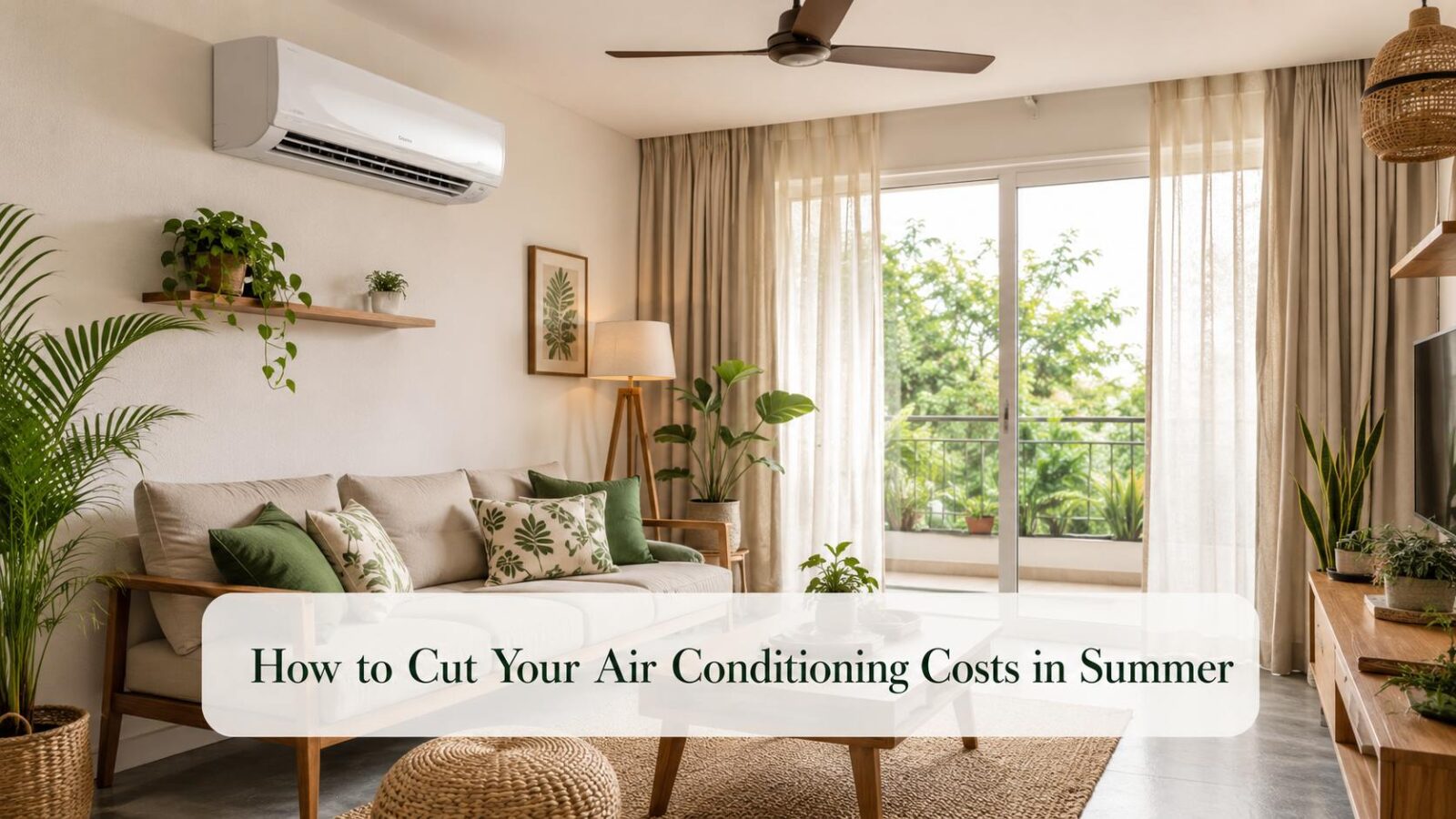
In summer, air conditioning is usually the single biggest part of a home’s energy use, often dwarfing everything else combined. The good news is that cooling costs are unusually responsive to a handful of changes, several of which cost nothing at all. Most people leave easy savings on the table because they assume cutting cooling costs means cutting comfort. It does not. This guide ranks the changes from free to worth-the-money, with realistic effects, so you can knock a large slice off your cooling cost without sweating through the season. Start with the free ones.
The core fact behind all of it: every degree you lower the thermostat raises consumption by roughly 6%, and a struggling, dirty, or oversized unit wastes energy on top of that. Fix the settings and the unit, and the savings are immediate.
The free changes (do these today)
Ease the thermostat by a few degrees
The biggest free saving by far. Setting the cooling a few degrees warmer cuts consumption 25-30%, and most people are perfectly comfortable once they adjust, especially with a fan running. This single habit often saves more than every gadget combined.
Run fans alongside the cooling
A fan costs a tiny fraction of an air conditioner to run and circulates the cool air, letting you set the thermostat a couple of degrees higher for the same comfort. Always run the fan with the cooling, never instead of easing the temperature.
Close off heat and use the timer
Draw curtains against afternoon sun, shut doors to cool only the rooms in use, and use the sleep or timer function so the unit is not cooling an empty room all night. None of this costs anything.
The cheap fixes
- Clean or replace the filter regularly in season; a clogged filter forces the unit to work harder and wastes energy.
- Get the unit serviced before summer; clean coils and correct charge restore 10-15% of lost efficiency.
- Seal gaps around windows and doors so cooled air does not leak out and hot air does not seep in.
- Shade the outdoor unit from direct sun so it sheds heat more easily.
The worthwhile investments
Reduce heat coming into the home
The less heat enters, the less the cooling has to remove. Reflective roof treatment and insulation on the roof and sun-facing walls cut cooling load 15-25%, a structural saving covered in our home upgrades guide and especially in dedicated home insulation work. For top-floor and sun-facing homes, this is often the highest-value summer investment.
A smart cooling controller
For heavy users, a smart controller can schedule the cooling, nudge the temperature up automatically overnight, and stop it running in empty rooms. Whether the savings justify the cost is examined in our look at smart AC controllers, but for homes that cool for many hours a day, the automation pays back.
Replace an old unit with a high-efficiency model
An air conditioner over seven years old can use nearly double a new high-efficiency unit for the same cooling. If yours is ageing, a replacement is the biggest single hardware saving, and it sits alongside the other appliance upgrades in our home energy guide.
Right-size the unit when you replace it
When the time comes to replace an old unit, capacity matters as much as the efficiency rating. A unit that is too large for the room cycles on and off wastefully and dehumidifies poorly, while one too small runs flat out and never cools properly. Both waste energy.
- Match the capacity to the room size and sun exposure rather than buying the biggest unit available.
- Choose a variable-speed (inverter) model, which adjusts its output to match the load instead of switching fully on and off.
- Check the efficiency rating for the cooling capacity you actually need, not a generic figure.
Common mistakes
- Over-cooling the home and blaming energy prices for the result.
- Skipping the annual service, then losing efficiency to dirty coils and filters.
- Cooling the whole home when only one or two rooms are in use.
- Buying gadgets before doing the free changes that save the most.
- Keeping a decade-old unit running because replacing it feels expensive.
Editor’s note
The cheapest cool air you will ever have comes from easing the thermostat a few degrees and running a fan, and it costs nothing. People resist this, convinced they need the coldest setting to be comfortable, but give it a few days and most never go back. Layer on a clean filter, a pre-season service, and curtains against the sun, and you have cut a large chunk of the cost before spending on hardware. Save the controller and the new unit for after the free and cheap wins are in place.
Frequently asked questions
What temperature should I set the cooling to save money?
A few degrees warmer than you might instinctively choose. Every degree lower raises consumption by around 6%, so easing the setting can cut running cost by a quarter, and a fan makes that temperature perfectly comfortable.
Does servicing my air conditioner really cut costs?
Yes. A clogged filter and dirty coils make the unit work harder for the same cooling. A pre-season service that cleans these and checks the system can restore 10-15% of lost efficiency, paying for itself quickly.
Is a variable-speed (inverter) unit worth the higher price?
For regular users, yes. These units vary their speed instead of switching fully on and off, using markedly less energy over a season. The savings typically recover the price premium within a few years of normal use.
Should I switch the cooling off when leaving the room briefly?
For short absences of a few minutes, leaving it on at a sensible temperature is usually fine, since restarting uses a burst of energy. For longer absences, switching it off, or using a timer or controller, clearly saves more than keeping an empty room cool. The simplest rule is to cool only the rooms actually in use.
Do fans actually help if I am running the air conditioner anyway?
Yes, noticeably. A fan moves air so you feel cooler at a higher thermostat setting, which lets you ease the temperature a couple of degrees for the same comfort. Since a fan costs a tiny fraction of cooling to run, pairing the two almost always lowers total energy use. The mistake is using a fan instead of easing the thermostat rather than alongside it.
How often should I service my air conditioner?
Once a year, ideally just before the cooling season, is enough for most homes. A service that cleans the filter and coils and checks the system restores efficiency the unit loses to dirt over time. Between services, cleaning or replacing the filter yourself every few weeks in heavy use keeps it breathing freely and protects much of that efficiency.