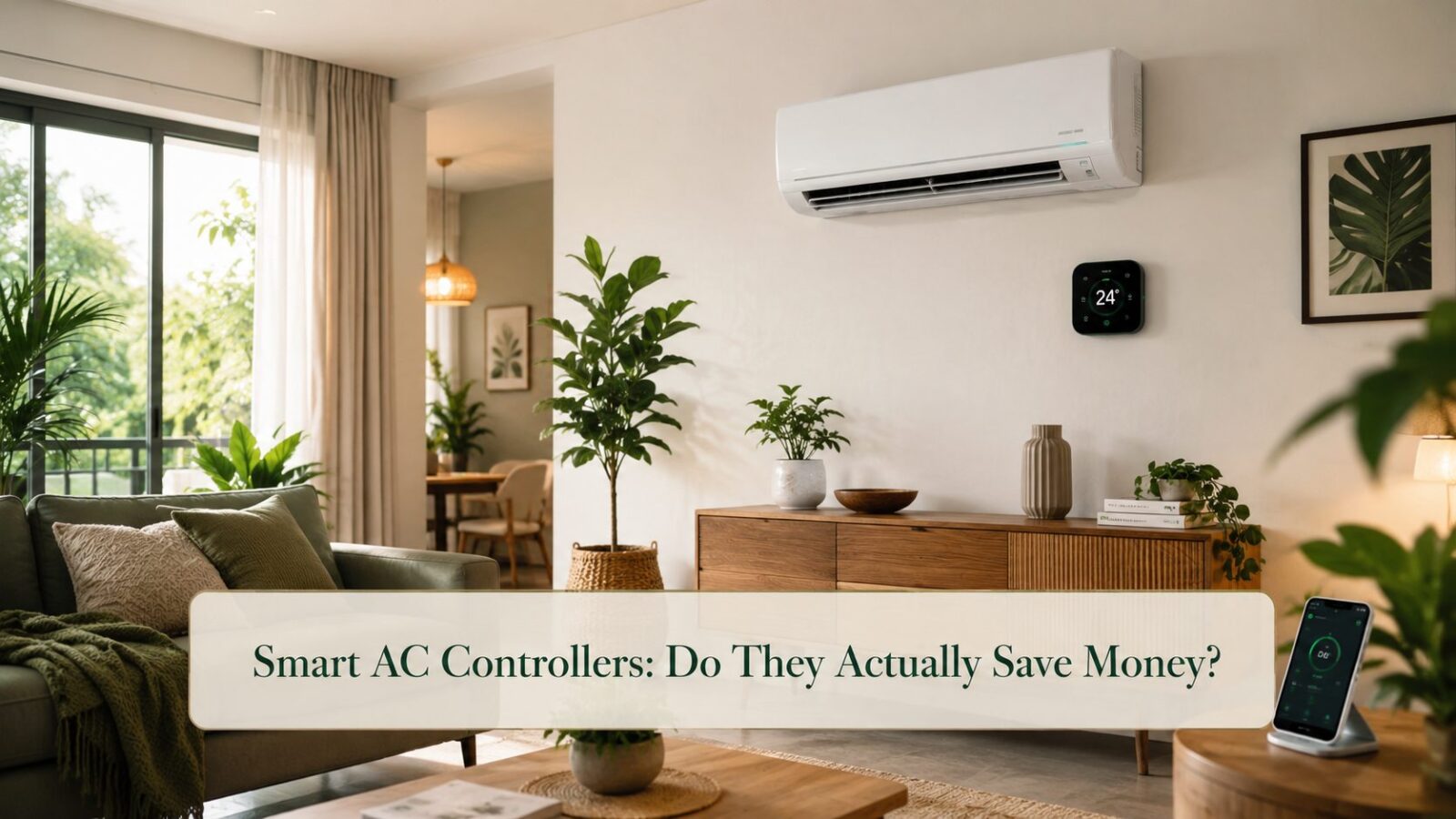
Smart AC controllers, small devices that take over your existing air conditioner’s remote functions and add scheduling and app control, are marketed as an easy way to cut cooling costs. For some homes they genuinely deliver; for others they are an expensive way to do what the unit’s own timer already does. Since cooling is the biggest energy user in most homes during summer, anything that manages it well has real potential, but the savings depend almost entirely on how you use the controller, not on owning one. Here is the honest assessment, so you can judge whether it fits your home.
The key idea is that a controller does not make your air conditioner more efficient; it makes you use it more efficiently, by automating the good habits you would otherwise forget. If you already cool carefully, the gains are smaller; if you do not, they can be substantial.
What a smart AC controller actually does
- Scheduling: turns the cooling on and off at set times, so it never runs in an empty home or all night.
- Temperature automation: nudges the set point up automatically, for example after you fall asleep.
- Geofencing: switches the cooling off when your phone leaves home and on as you return.
- Usage tracking: shows how many hours the unit ran, making waste visible.
- Remote and voice control: convenience features that do not themselves save energy.
Where the savings come from
Every unit of energy saved traces back to one of three things: fewer running hours, a higher average temperature, or not cooling empty space. A controller automates all three. The biggest single lever remains the thermostat setting, easing it a couple of degrees, which is exactly the free habit covered in our guide to cutting your cooling costs. The controller’s value is making that habit automatic and consistent, every night, without you thinking about it.
When a controller is worth it
- You cool for many hours a day through a long, hot season.
- You often forget to switch the unit off or leave it running overnight too cold.
- Your schedule is irregular, so scheduling and geofencing prevent cooling an empty home.
- You want usage data to understand and reduce your cooling consumption.
When to skip it
- You already cool sparingly and at a sensible temperature.
- Your unit has a built-in timer and app that you actually use.
- You cool only occasionally, so the payback would take years.
- You have not yet done the free changes that save more for nothing.
How it fits the bigger picture
A smart AC controller is one of the few connected devices that targets the biggest user in the home, which is why it ranks highly in our roundup of smart devices for energy savings. But it should come after the free and cheap wins, easing the thermostat, servicing the unit, blocking the sun, not before. Treat it as a tool to lock in good cooling habits permanently, and pair it with reducing the heat that enters the home in the first place.
Setting it up for real savings
A controller only saves if it is set up to. Out of the box it does nothing useful, so the configuration is where the benefit actually comes from.
- Set a sensible target temperature rather than carrying over an old, too-cold setting.
- Schedule an automatic increase overnight, when a degree or two warmer goes unnoticed during sleep.
- Use geofencing or a timer so the unit is never cooling an empty home for hours.
- Review the usage data after a few weeks and tighten the schedule where you see waste.
Common mistakes
- Buying a controller while still cooling far too cold, undoing most of the benefit.
- Expecting the device itself to save energy, rather than the habits it automates.
- Paying for one when your unit’s own timer would do the same job.
- Ignoring compatibility; not every controller works with every unit.
- Skipping the free changes that save more than any gadget.
Editor’s note
A smart AC controller is worth it for exactly one kind of household: the heavy user who keeps forgetting to manage the cooling sensibly. For that home, automating a higher overnight temperature and switching off an empty-room unit can save real money, night after night. For the disciplined user who already cools at a sensible temperature for limited hours, the controller is mostly convenience. Be honest about which you are. If you suspect you are the forgetful type, the device may pay for itself; if not, your money is better spent reducing heat coming in.
Frequently asked questions
Do smart AC controllers really lower costs?
They can, for heavy or forgetful users, by automating fewer running hours and higher temperatures. The savings come from changed usage, not the device itself, so a disciplined user who already cools sensibly saves much less.
Will a smart controller work with my air conditioner?
Most work with any unit that uses an infrared remote, since they mimic the remote’s signals. Still, check compatibility before buying, especially for unusual models, to be sure all functions are supported.
Is a controller better than just using the timer?
Only if you want automation the timer cannot do, like temperature changes through the night, geofencing, and usage tracking. If you reliably use your unit’s built-in timer at a sensible temperature, a controller adds convenience more than savings.
Can a smart AC controller harm my air conditioner?
No, a reputable controller simply replicates the signals your existing remote already sends, so it does not interfere with the unit’s internals. The one thing to avoid is very frequent on-off cycling through poorly chosen schedules, which is hard on any air conditioner; sensible scheduling that lets it run in reasonable stretches is gentler and more efficient.
Do smart AC controllers need constant internet to work?
Most rely on a connection for app control, scheduling, and remote access, so a dropped link can disable those features, though many keep running their last schedule locally. If you face frequent internet or power interruptions, choose a controller that retains schedules offline and continues basic operation without the cloud, so a brief outage does not leave the cooling uncontrolled.
Will a controller help if I only use cooling occasionally?
Less than you might hope. The savings come from automating better habits across many hours of use, so a household that cools only occasionally has little for the controller to optimise and a long payback. If you cool rarely and already at a sensible temperature, your money is better spent elsewhere, such as reducing the heat that enters the home.
Is a smart controller better than buying a new air conditioner?
They solve different problems. A controller optimises how you use an existing unit, while a new high-efficiency unit reduces how much energy the cooling itself draws. If your unit is old and inefficient, replacing it saves more; if it is reasonably modern but poorly managed, a controller may be the cheaper win. Doing the free habits first tells you which one you actually need.