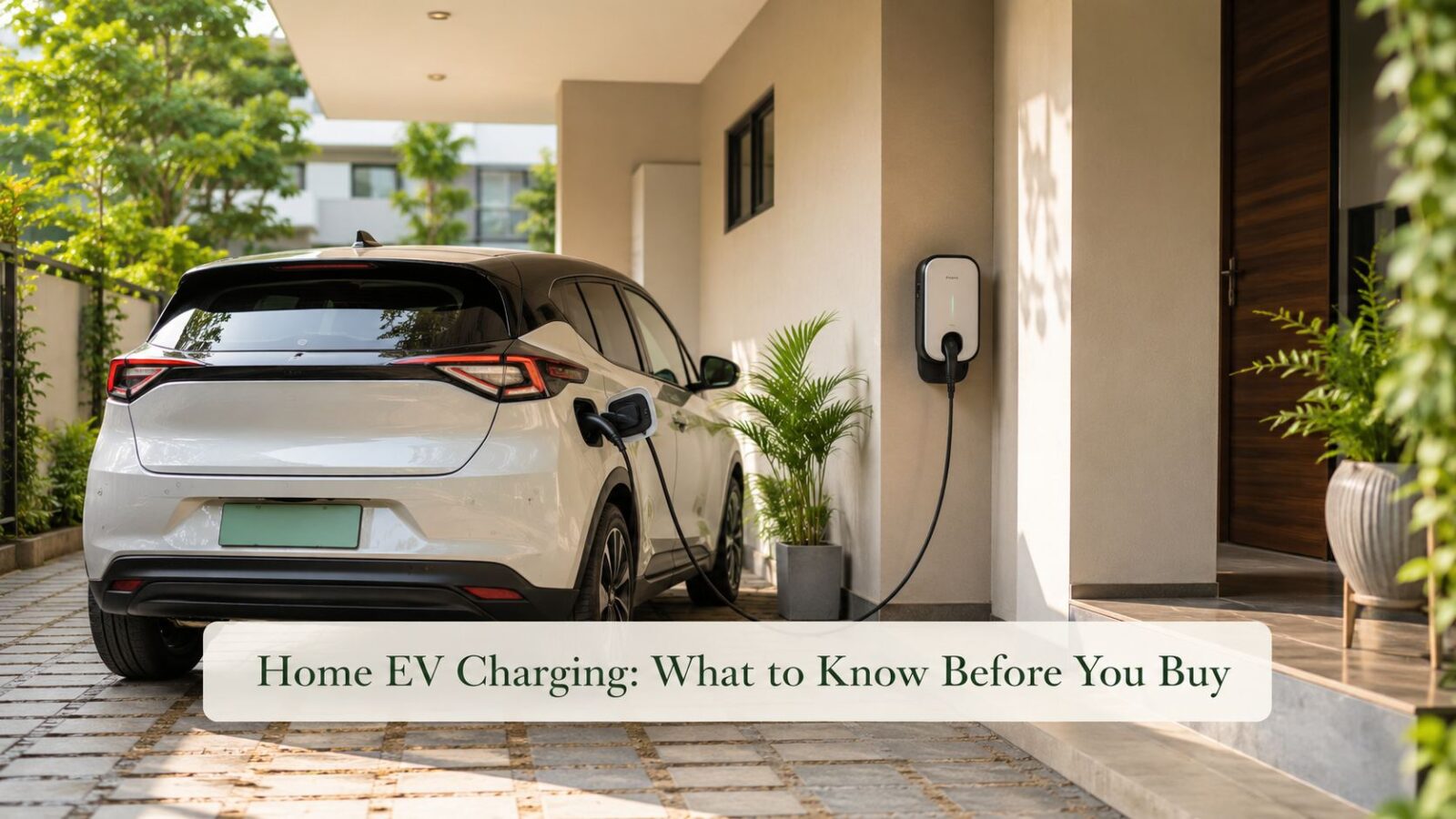
For most electric-vehicle owners, the car or scooter spends its nights at home, which makes home charging the single biggest factor in how cheap and convenient electric ownership turns out to be. Charged at home, an electric vehicle costs a fraction of petrol per kilometre; reliant on public chargers, the maths and the convenience both suffer. Yet home charging needs a little planning that buyers often skip until after purchase. This guide covers what to know before you buy: charger types, realistic running costs, and how charging fits a future-ready home, all at a practical, consumer level.
The reassuring part is that home charging is not exotic. For a two-wheeler it can be very simple; for a car it usually means a dedicated home charger fitted by a qualified professional. The planning is mostly about doing it safely and cheaply, not about complexity.
Charger types and what you need
- Portable charger: the slowest option, adequate for light overnight charging and smaller vehicles.
- Dedicated home charger: the standard for cars, charging far faster, typically arranged through the dealer or a qualified installer.
- Public fast charging: useful on the road but not for daily home use, and harder on the battery if overused.
Match the charger to your vehicle and daily distance. Most home users charge overnight at a modest rate, which is gentler on the battery and lets you take advantage of cheaper hours where available.
Safety and getting it installed
This is the part to plan before buying, and it is best left to a professional. A car charger should be installed by a qualified electrician who can confirm your home can support it safely, rather than improvised from an ordinary socket and an extension lead.
- Have a qualified electrician assess your home and handle the installation.
- Site the charger sensibly near where you park, with weather protection if outdoors.
- Ask your installer about any approvals needed and the safest setup for your home.
- Check whether cheaper off-peak hours are available where you live to lower running costs.
What it costs to run
The running cost is simply your energy rate times the units the vehicle needs, which works out far below petrol for most users. Charging during cheaper hours, where available, lowers it further. For homes with rooftop solar, daytime charging can be especially cheap, tying electric ownership neatly to the logic in our solar cost analysis and to sizing your system in our guide to how many solar panels a home needs.
How EV charging fits a future-ready home
Home charging is one of the genuine shifts shaping homes, featured in our look at smart home trends for 2026. Planning for it, even before you buy an electric vehicle, by ensuring a sensible parking spot and asking an installer what your home would need, future-proofs the home cheaply. Smart chargers that schedule charging for cheaper hours or to match solar generation add a further layer of saving, and fit the staged, savings-first approach to home technology that pays off across the board.
Battery health and charging habits
How you charge affects how long the battery lasts, and a few gentle habits protect the most expensive part of the vehicle.
- Favour slower home charging over frequent public fast charging, which generates more heat and stress over time.
- Avoid routinely charging to a full 100% or running down to empty; a middle band is gentler for daily use.
- Charge in the cooler parts of the day where possible, since heat is hard on battery life.
- Follow the manufacturer’s guidance, which is tuned to your specific battery.
Common mistakes
- Buying an electric vehicle without checking what home charging will involve.
- Improvising with a random socket and extension lead instead of a proper installation.
- Relying on public fast chargers for daily needs, losing the cost advantage of home charging.
- Ignoring cheaper off-peak hours that could make charging significantly less expensive.
- Overusing fast charging, which stresses the battery more than gentle home charging.
Editor’s note
The smartest thing a prospective electric-vehicle owner can do is talk to a qualified installer before talking to a car dealer. Most home-charging headaches come from treating charging as an afterthought. Sort out a proper, safely installed home charger first, then choose one matched to your vehicle and daily distance, and charge gently overnight. Done in that order, home charging is what makes an electric vehicle genuinely cheap to run; skipped, it becomes the frustrating part of an otherwise good decision.
Frequently asked questions
Can I charge an electric car from a normal home socket?
For a smaller vehicle or light overnight charging, a portable charger can work, but for a car most owners are better served by a dedicated home charger installed by a professional. An ordinary socket charges slowly and is not ideal for daily car use.
How much does it cost to charge at home?
Far less than petrol for most users. The cost is your energy rate multiplied by the units the vehicle needs, and charging during off-peak hours, or from rooftop solar, lowers it further.
How long does it take to charge at home?
It depends on the charger and the vehicle’s battery. A portable charger is slow and suits smaller vehicles or overnight top-ups, while a dedicated home charger refills a car far faster, often comfortably within a night. For most owners who charge overnight, a moderate rate is more than enough to start each day full.
Is home charging cheaper than public charging?
Almost always. A home energy rate is typically far lower per unit than public fast-charging rates, which include the operator’s costs and margins. Home charging overnight, especially on any off-peak rate or from solar, gives the lowest cost, with public charging best reserved for longer journeys.
Does home charging put a lot of strain on my home?
A car charger does add meaningful demand, which is exactly why it should be assessed and installed by a qualified electrician rather than improvised. A professional can confirm your home can support it safely and set it up correctly. Once installed properly, overnight charging at a moderate rate is well within what a suitably prepared home handles without trouble.
Is it bad to charge an electric vehicle every night?
Not in itself, especially at a gentle home charging rate. What is harder on the battery is routinely charging to a full 100% and letting it sit there, or frequently using high-power fast charging. For daily use, charging overnight to a sensible level and following the manufacturer’s guidance keeps the battery healthy for years.
Can I install a home charger myself?
It is strongly advisable not to. A car charger adds significant electrical demand and should be assessed and fitted by a qualified electrician who can confirm your home supports it safely and install it correctly. Improvising with ordinary sockets and extension leads is both slow and unsafe, so this is one job where professional installation is well worth the cost.